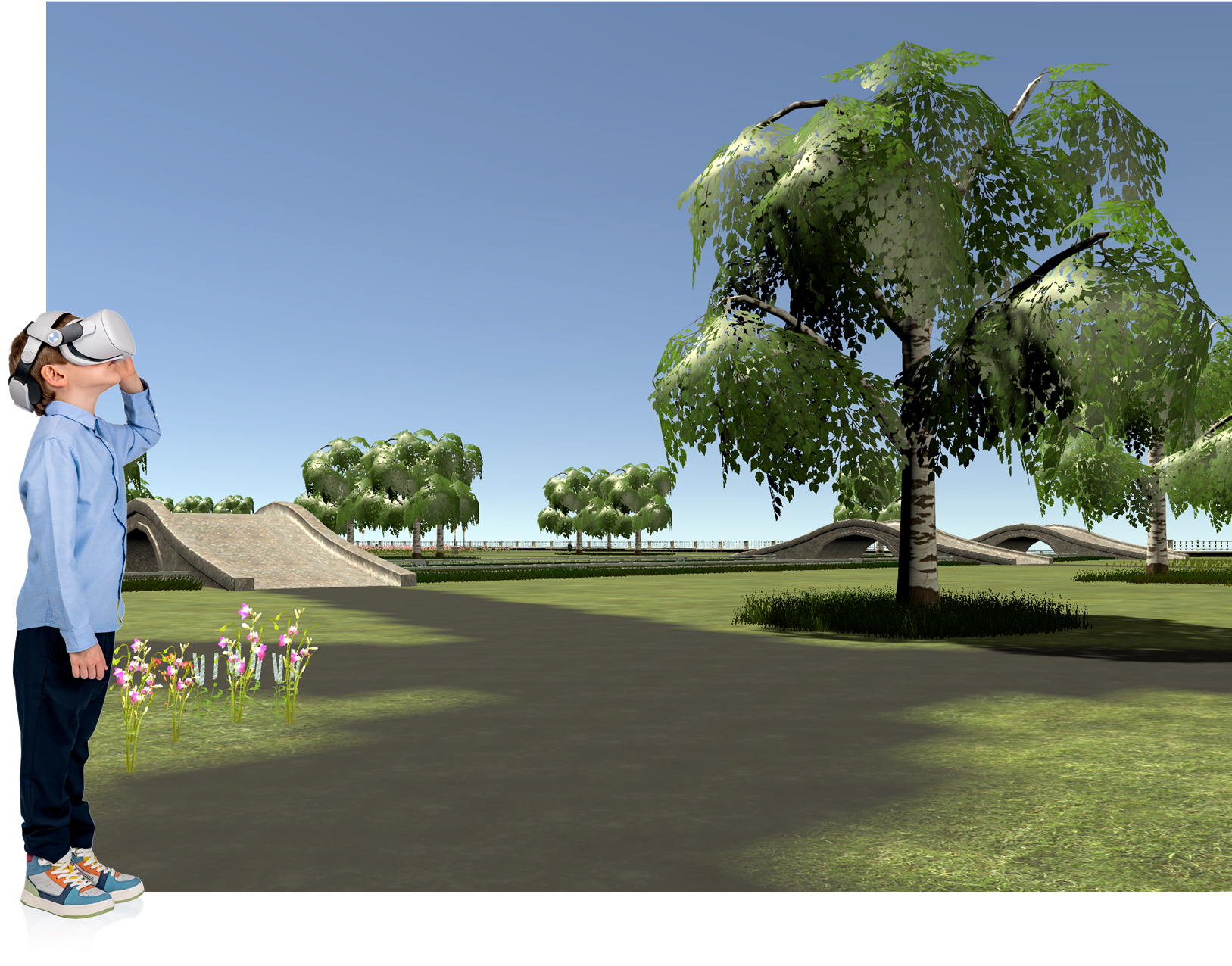
Spatial orientation and navigation are essential cognitive abilities that allow people to understand and move through their environment. However, these skills are increasingly challenged by the widespread use of digital navigation systems, which often replace active spatial reasoning. At the same time, there are still few reliable tools for assessing large-scale spatial abilities such as navigating environments or relating maps to real spaces.
This project investigates how virtual environments and digital geogames can be used both to measure and train spatial orientation skills, particularly the ability to transform spatial information between maps and environments. Using immersive virtual environments and interactive digital maps, we create controlled but realistic navigation scenarios in which participants solve spatial tasks such as identifying landmarks, determining directions, or locating places on a map.
Project Goals
Competence Test Develop and evaluate a virtual reality–based assessment for large-scale spatial abilities. The test focuses on spatial transformations between maps and environments and includes tasks such as identifying landmarks, locating positions, and determining directions. The goal is to create a standardized and location-independent instrument that can reliably measure spatial orientation skills.
Training Environment Design interactive training environments that help learners improve spatial orientation and navigation skills. Using digital geogames and map-based tasks, participants practice key spatial competences such as landmark recognition, spatial configuration, and route memory in engaging learning scenarios.
Technical Framework
The project builds on earlier research on the location-based geogame GeoGami and extends this work by developing location-independent virtual assessment environments. These environments make it possible to study spatial navigation systematically while keeping experimental conditions consistent across participants and locations.