

Protected: GeoGami for science
A research app for studying spatial behaviour
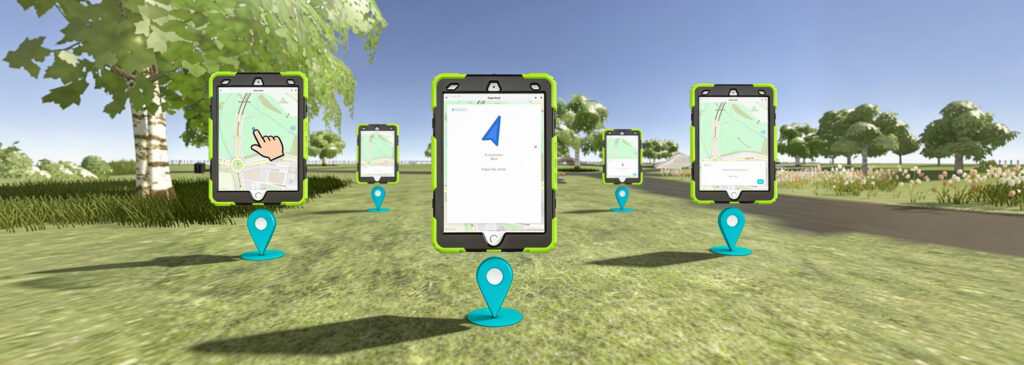
GeoGami® empowers researchers to design and conduct experiments involving participant navigation and interaction within real or virtual environments. From wayfinding and spatial orientation studies to research on visual attention, scene perception, evacuation behaviour, and navigation instructions, GeoGami® offers flexible tools for guiding participants, monitoring their behaviour, and collecting spatial data.
All recorded data can be exported as CSV files, enabling straightforward statistical analysis using standard research software.
Studies across different environments and platforms
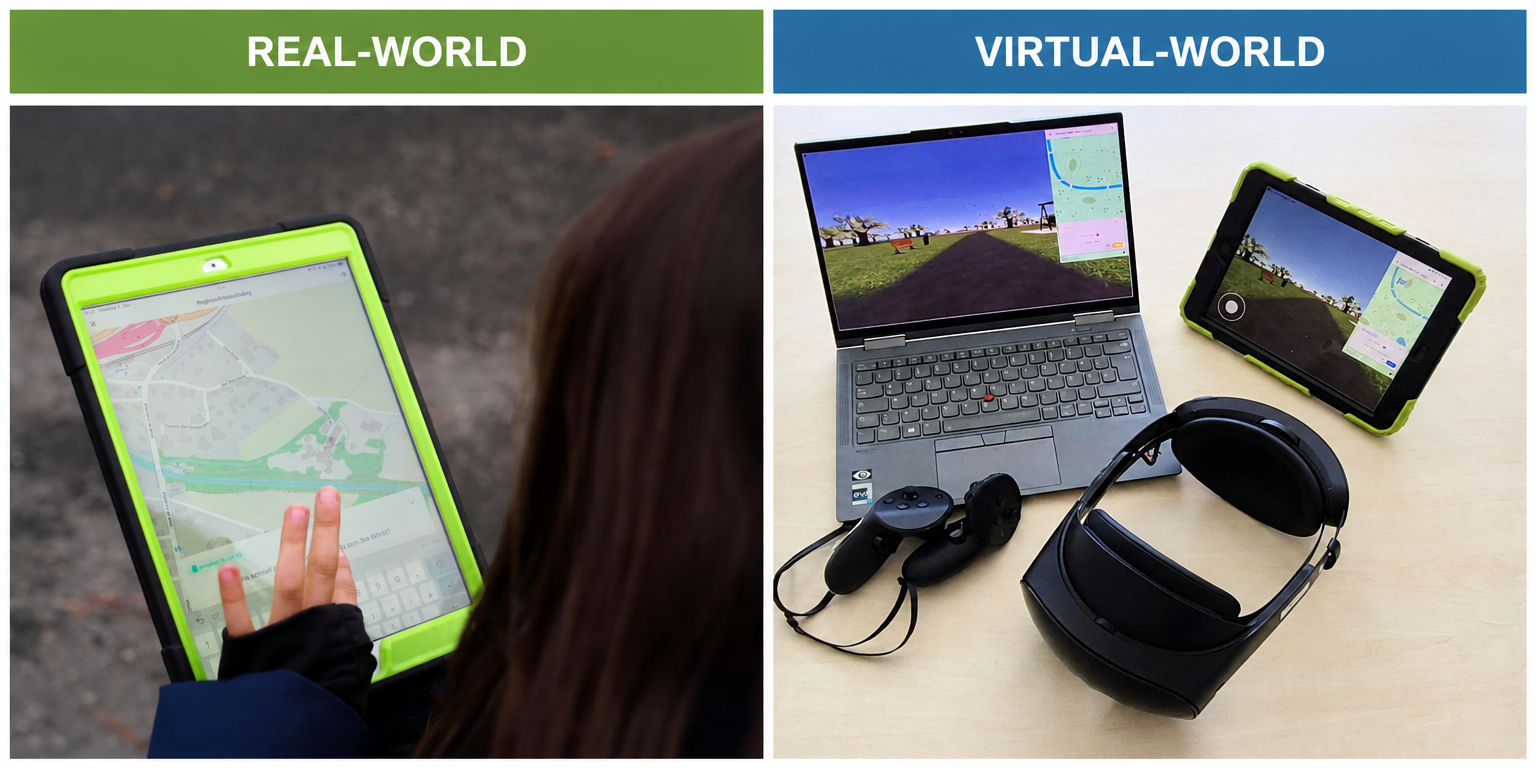
You can run studies across a wide range of environments and platforms: Conduct single-participant or group studies in real-world settings, or deploy experiments in virtual environments on computers and tablets. For a fully immersive experience, studies can also be run using VR headsets.
For each study, you define a starting location and a sequence of tasks. Participants are guided through the experiment by completing each task in the specified order. Throughout the experiment, their movements and viewing directions are continuously recorded and made available to the experimenter for easy data analysis.
Experimental Tasks
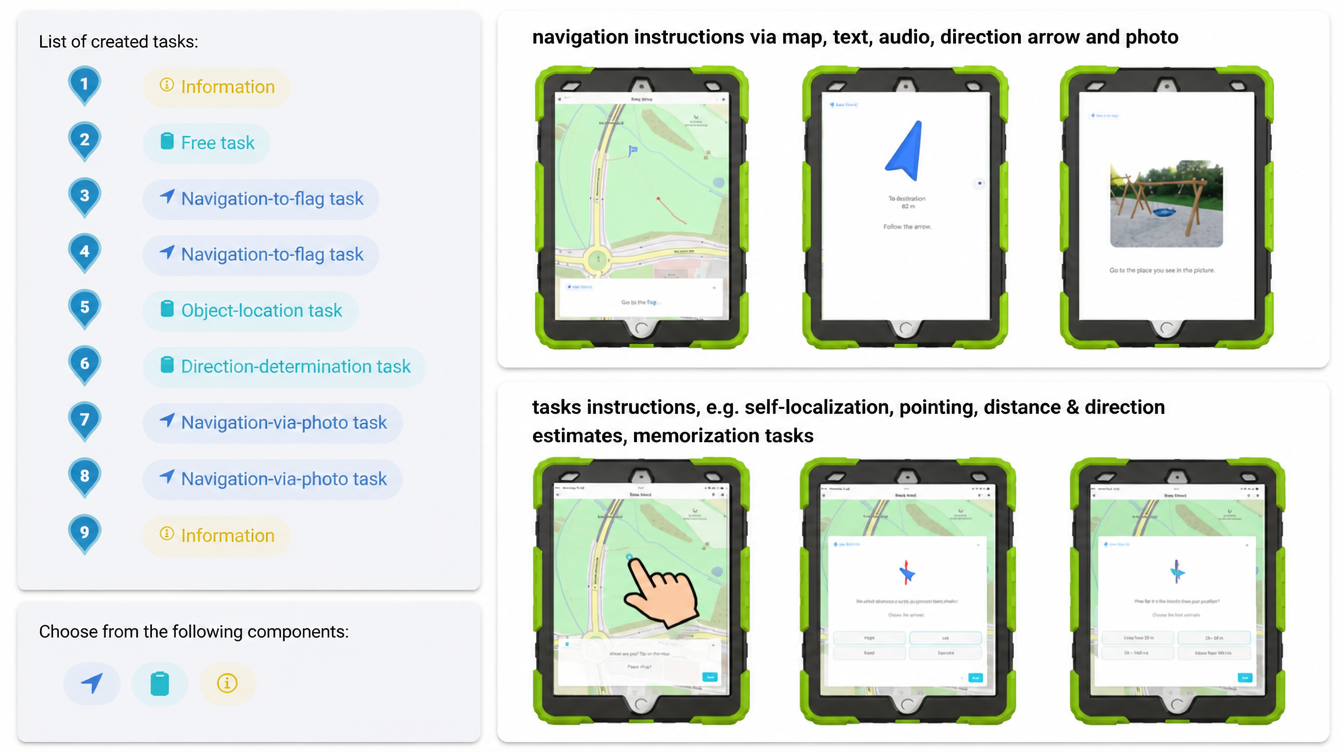
Every study is fully customizable. The experimenter defines which tasks participants complete, in which order, and at which locations within the environment.
A wide range of navigation instructions can be used, including map-based guidance, text or audio instructions, landmark references, and directional arrows. At different locations, additional tasks can be integrated, such as self- or object-localization, pointing tasks, distance and direction estimates, multiple-choice questions, and many other response formats.
Environments
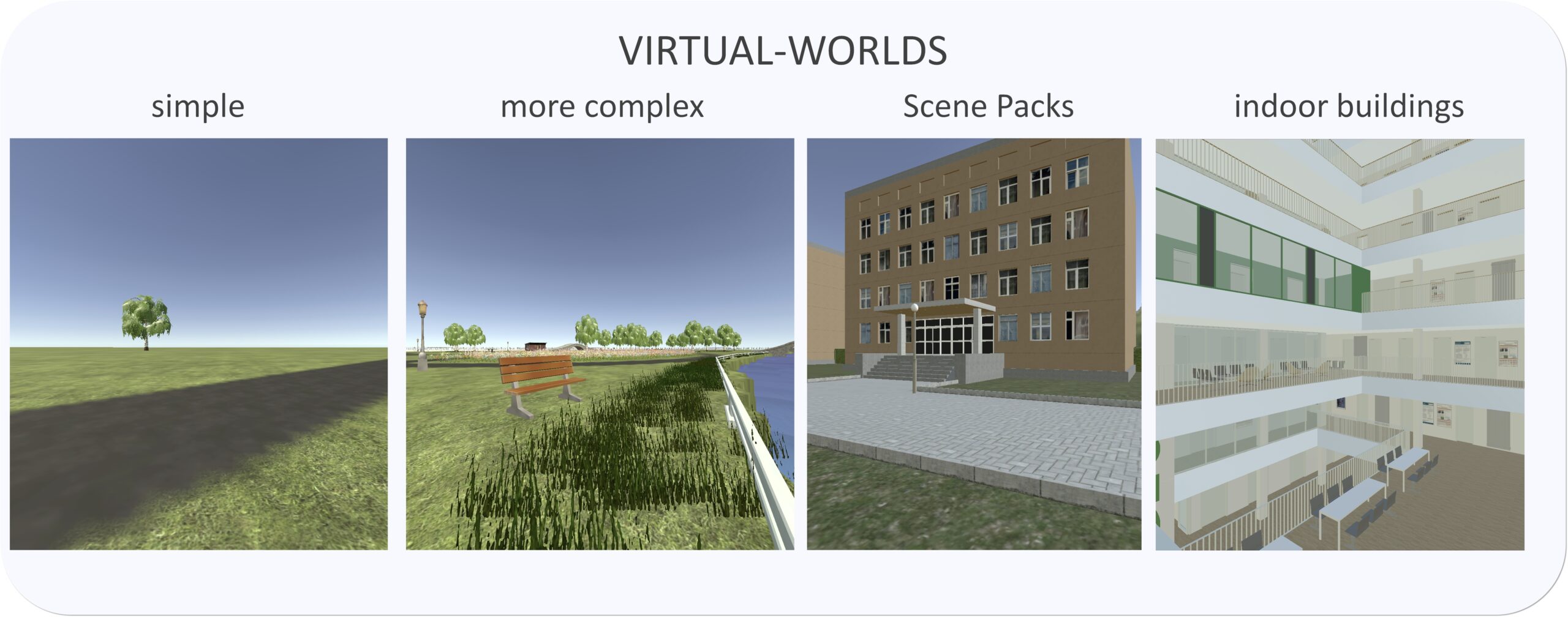
With GPS and OpenStreetMap integration, GeoGami can be used anywhere in the world. In virtual environments, settings can be designed quickly and easily—from simple, controlled environments to complex, multi-layered buildings.
All VR worlds are Unity-based. In addition to custom-built environments, ready-to-use out-of-the-box worlds can also be integrated.
The App
Download the app from the app store or explore it on the web.

Publications
2026
Enhancing Spatial Orientation and Navigation Skills through Digital Geogame-Based Training Interventions in Educational Settings
Müller, Helen; Qamaz, Yousef; Schwering, Angela
Professional Geographer
2024
GeoGami: A Research Software for Training and Measuring Navigational Map Reading Competence
Schwering, Angela; Aleksandrov, Mitko; Qamaz, Yousef
2023
Assessing navigational map reading competencies with the location-based GeoGame “GeoGami”
Bistron, Janina Schwering, Angela
Journal of Geoscience Education
Individualization in Spatial Behaviour and Map Reading
Schwering, Angela Krukar, Jakub Seep, Jana Qamaz, Yousef
2022
Educational location-based geogame “GeoGami” for map-related spatial learning
Bistron Janina Qamaz Yousef Schwering Angela
Children’s Navigational Map Reading Strategies and Implications for Educational Geogames
Bistron, Janina; Schwering, Angela; Özkaya, Ilhan Talha; Qamaz, Yousef
Geotechnology-based Spatial Learning: The Effects on Spatial Abilities and Sketch Maps in an Inter-Cultural Stud
Bartoschek, Thomas; Schwering, Angela
Experimental evaluation of using BLE beacon for outdoor positioning in GPS-denied environment
Qamaz, Yousef; Schwering, Angela; Bistron, Janina
2013
Ori-Gami - Fostering Spatial Competency Development and Learning
Bartoschek Thomas, Schwering Angela, Li Rui
Ori-Gami - An App fostering spatial competency development and spatial learning of children
Bartoschek Thomas, Schwering Angela, Li Rui, Münzer Stefan